Zepel as part of the James Dunlop Group is committed to being a socially responsible global business.
Environmental Standards

Along our journey to creating a more sustainable future, our studios are working to incorporate innovative textiles into our collections. By partnering with mills and fabric suppliers who adhere to the highest possible environmental criteria and international standards we can reduce our environmental impact and broaden the number of environmentally conscious products in our range.
These certifications enhance product transparency and substantiate manufacturers’ sustainability claims through audits and scientific data, collated by unbiased third-party organisations. Simply filter the Product Search page by the relevant standards under the ‘Environmental Certifications’ section.
To read more about other initiatives within Zepel visit our Social Responsibility page.

Our Eco Standard
Our Eco Standard is awarded to textiles which are composed of conscious fibres and meet our key environmental certifications. Our range of eco-friendly fabrics are easily identified by the below label.
Textiles achieving our Eco Standard are:
COMPOSED OF LEAST 50% RECYCLED OR ORGANIC FIBRE CONTENT
STANDARD 100 BY OEKO-TEX CERTIFIED
ISO 14001 ENVIRONMENTAL MANAGEMENT CERTIFIED
Global Certifications
Global Recycled Standard (GRS)
The Global Recycled Standard (GRS) verifies at least 50% recycled polyester and tracks it from the source/recycler to the final product.

Recycled Fabric Calculations
The technical advancement of recycled yarn production has led to textiles which are not only more environmentally friendly but emulate the soft handle of virgin fibres. By choosing fabrics composed of recycled polyester we can extend the resource’s life cycle and reduce the environmental impact.
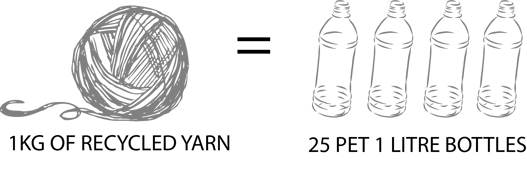
Polyester can be repurposed into recycled yarn from a range of sources including plastic bottles, packaging materials, or textile and marine waste; we have chosen to highlight post-consumer PET plastic bottles. For example:
1kg of recycled yarn is equivalent to 25 plastic 1 litre bottles. We can then calculate the number of plastic bottles used per square metre using the weight of the fabric (GSM) and percentage of recycled yarn.
Look for this calculation across our product pages to quantify the environmental impact.
Eco FAQS
Can recycled textiles be recycled again?
Recycled textiles can generally be recycled again, although the process and feasibility vary. Mechanical recycling breaks down fibers for new yarns or fabrics, but fibers weaken with each cycle. Chemical recycling breaks down fibers into components for new fibers or materials. Blending recycled textiles with virgin fibers can improve durability. Limitations include quality, contaminants, and non-recyclable components.
How did you calculate how many PET bottles are used per square metre of products that contain recycled polyester?
1kg of recycled yarn is equivalent to 25 plastic 1 litre bottles. We can then calculate the number of plastic bottles used per square metre using the weight of the fabric (GSM) and percentage of recycled yarn by multiplying the GSM by the percentage of recycled fibred then dividing it by 25.
Do you know how many recycled bottles would be used to make one sofa or a set of curtains using fabric from your Eco Range?
A 3 seater sofa on average uses approximately 486 1Litre PET bottles. Figures represent an average calculation across our recycled upholstery products, based on known global standards.
A 5 metre set of curtains on average has approximately 143 1Litre PET bottles. Figures represent an average calculation across our recycled drapery products based on known global standards. Curtains calculated as S-Fold header, using standard heights.
Are all your products that contain recycled polyester made from plastic bottles?
No, we are using plastic bottles to to quantify the environmental impact made by choosing these Eco products however not all of them we know the origin of the recycled polyester.